
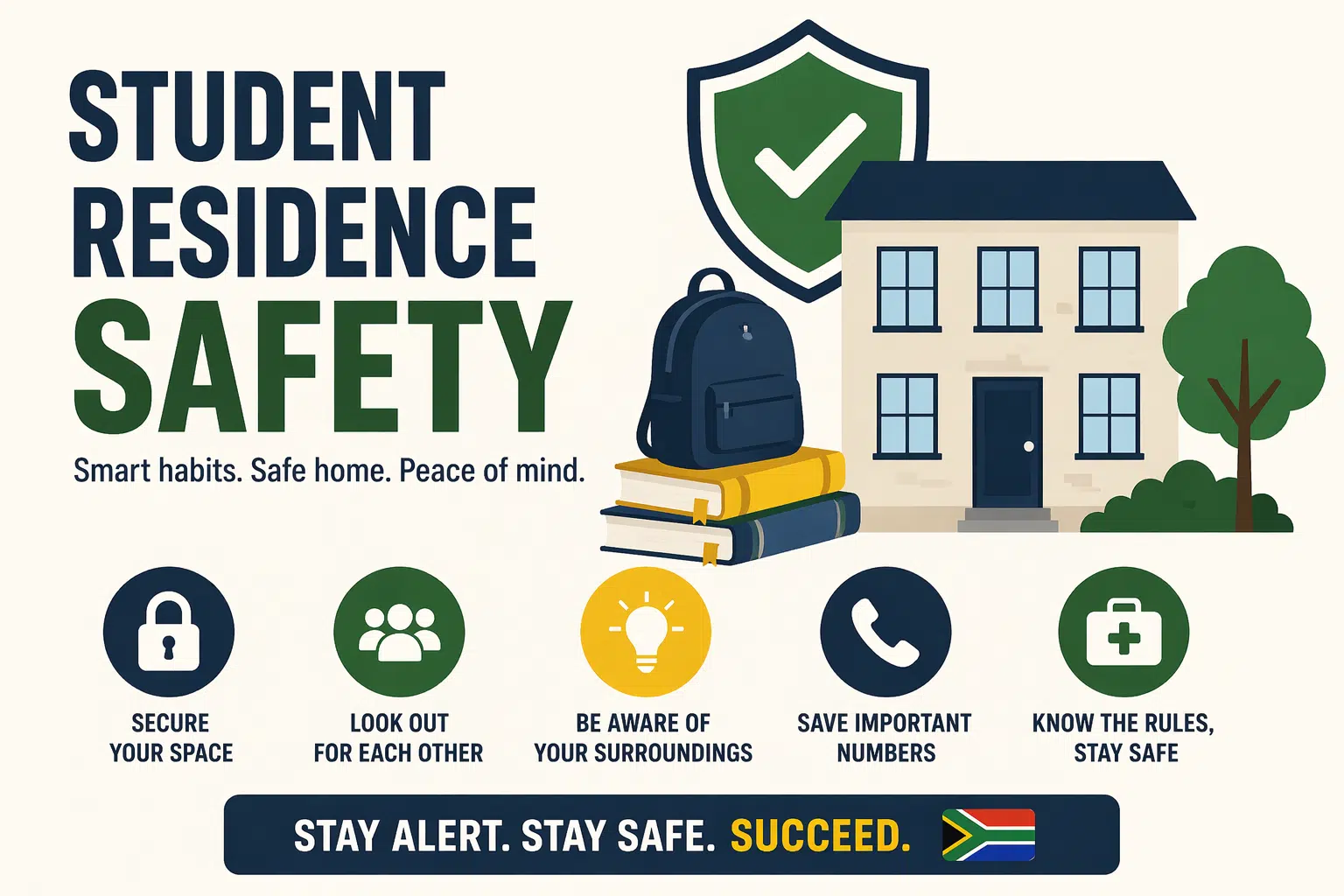
Student Residence Safety Checklist
Student Residence Safety Checklist South Africa
Choosing student accommodation can feel overwhelming. Price, location, and room size all matter. However, safety should never sit in the background. A strong student residence safety checklist helps families check how a property works each day.
Many student residences look good online. Yet photos do not show how well a site controls access, handles visitors, or responds after hours. Because of this, parents and students need a clear student residence safety checklist before making a final decision. A student residence should provide more than a room. It should also provide a safer and more controlled living environment.
Student Residence Safety Checklist for the Main Entrance
First, assess the main entrance. If the front gate, reception point, or entry door is poorly managed, the rest of the property already has a problem. A residence should know who comes in, who leaves, and who should not be on site.
Look at whether the entrance is staffed, monitored, or controlled by a proper access system. Also check whether visitors must sign in and whether residents can report unknown persons easily. If people can walk through the main entrance without challenge, the property has a weak point from the start.
Student Residence Safety Checklist for Visitor Control
Visitor handling matters in student housing because shared buildings have regular movement. For example, friends, delivery drivers, contractors, and unknown persons can all arrive at different times of day. Therefore, the residence should have clear rules for guest access.
Ask whether visitors are screened, whether they need approval, and whether after-hours visits are limited. In addition, find out if staff actually enforce these rules. A policy on paper means very little if nobody applies it in practice.
Student Residence Safety Checklist for Lighting
Next, check the lighting. This is one of the easiest things to review. It is also one of the most important. Entrances, walkways, parking areas, staircases, and outside gathering points should all be well lit. Poor lighting gives cover to opportunistic crime and also makes students feel unsafe when returning home at night.
So, walk around the property if possible. Do not only view the inside. Instead, look at the route from the gate to the entrance and from the street to the building. A residence may look modern during the day, yet feel very different at night.
Student Residence Safety Checklist for Room Security
A student residence needs strong external and internal control. The building may have a secure gate, but room-level security matters too. Bedroom doors, shared corridors, stairwells, and internal access points all need attention.
Check whether bedroom locks look secure and whether shared areas are visible and well maintained. Also ask how management handles lost keys, tags, or access cards. If a student loses access credentials, the residence should act quickly. Otherwise, other residents may face unnecessary risk.
Student Residence Safety Checklist for CCTV and Monitoring
CCTV can add value, but only when it is placed correctly and supported by proper monitoring. Cameras at entrances, passages, and shared areas can improve oversight. However, cameras alone do not solve weak management.
Ask where cameras are placed, whether they cover main access points, and who reviews incidents when something happens. In the same way, ask whether the residence has after-hours support or off-site monitoring. A visible camera system helps, but a working response process matters more.
Student Residence Safety Checklist for After-Hours Procedures
A student residence should have a clear process for evenings, weekends, and emergencies. Many incidents happen outside office hours. Because of this, families should ask who is available at night and what students must do when they need help.
Check whether the residence has a reporting line for suspicious activity, disturbances, or urgent problems. Also ask how quickly staff respond to after-hours issues. If management has no clear answer, that is a warning sign.
Student Residence Safety Checklist for Site Rules
A safer residence usually has clear rules and applies them consistently. This does not mean the property should feel harsh or restrictive. Instead, it should have structure. Rules around visitors, noise, shared spaces, access, and reporting help the site run more smoothly.
Students need independence, but they also need a living environment with boundaries. When staff enforce site rules properly, the residence becomes easier to manage and safer to live in. By contrast, weak rule enforcement often leads to repeated problems.
Student Residence Safety Checklist for Property Condition
The condition of the building often tells you how the site is managed. For instance, broken lights, damaged gates, loose locks, poor upkeep, and untidy shared areas can all point to weak control. Good management usually shows in small details.
So, look at how clean and organised the common areas are. Then look at the state of doors, windows, fences, and access points. A residence that ignores maintenance issues may also ignore safety issues.
Student Residence Safety Checklist Before You Pack
Before packing, students should confirm what the residence already provides. Most university and college residences include basic furniture such as a bed, mattress, desk, chair, wardrobe, and curtains. In some cases, the residence may also provide Wi-Fi, shared kitchens, and laundry facilities. However, some buildings run on a self-catering basis, so students need to check the setup before arrival.
For this reason, students should read the residence acceptance letter carefully or contact the residence office directly. This helps them avoid bringing unnecessary items. It also helps them identify what essentials they still need to buy before move-in day.
Student Residence Safety Checklist for Residence Rules
Safety should be a priority from the start. Many student residences do not allow items such as candles, heaters, irons, and certain cooking appliances because they increase fire and safety risks. Therefore, students should check the residence rules early so they do not arrive with items they cannot keep in the room.
It is also a good idea to use lockable storage for valuables. Important items such as passports, identity documents, cash, bank cards, and small electronics should not be left unsecured in shared living spaces. In addition, first-year students should save important contact numbers on their phones, including campus security, residence staff, and residence managers.
Student Residence Safety Checklist for Moving In
Moving into residence can feel overwhelming, especially for students leaving home for the first time. Feeling anxious, unsettled, or homesick in the first few weeks is normal. However, students usually adjust more easily when they stay involved in orientation activities, join student groups, and keep in contact with family or trusted friends.
A few simple steps can also make the move smoother. For example, label your belongings, arrive early on move-in day, and use a checklist so that nothing important is forgotten. Most importantly, remember that residence life is not only about having a place to stay. It is also about building independence, forming friendships, and creating a stronger base for academic success.
Final Student Residence Safety Checklist
In the end, a useful student residence safety checklist should cover more than the room itself. It should cover access control, visitor handling, lighting, room security, CCTV, after-hours response, site rules, and upkeep. These checks help students and parents make a better decision before signing an agreement.
A strong student residence safety checklist makes safer student housing easier to judge. Ask practical questions. Look closely at the building. Then test how management responds. A good residence will answer clearly.
For properties in Cape Town, Mtunzini Group provides student accommodation security tailored to the site, the residents, and the daily movement on the property.
If you need Johannesburg-specific support, visit our Student Residence Security page for more information.